
The Sovereign Agent: Why Pure-PlayLLMs Are Failing the Enterprise ContactCenter
The initial wave of Generative AI adoption across enterprise contact centers and Business Process Outsourcing (BPO) providers promised a revolution. We were told that Large Language Models (LLMs) would seamlessly handle customer interactions, slash handle times, and make rigid, robotic phone trees a thing of the past.
But as deployments scaled, enterprise leaders hit an uncomfortable reality: unconstrained creativity is an operational liability. In high-stakes environments like enterprise service desks, relying purely on generative AI has introduced severe vulnerabilities—from conversational looping and hallucinated procedures to complete data-capture failures in noisy, accent-diverse environments. When an AI agent cannot guarantee that Step A always leads to Step B during a password reset or identity verification, it ceases to be an asset and becomes a risk.
So, how do we capture the natural fluid cadence of an LLM without sacrificing the ironclad control required by enterprise compliance?
The answer lies in a paradigm shift: The Hybrid Deterministic-LLM Architecture.
The Fallacy of the Pure-Play LLM
Mainstream communication platforms often treat voice AI as an administrative add-on rather than a core engineering discipline. They lack the underlying state-machine controls required to confine an LLM to explicit operational guardrails.
When a voice agent relies solely on an LLM to guide a call flow, it suffers from context drift. In practice, this looks like an agent repeating the same question three different ways, or worse, inventing corporate troubleshooting protocols on the fly.
To build a "Sovereign Agent"—one that truly owns the customer experience safely—enterprises must decouple conversational variance from business logic execution.
The Blueprint: Balancing Control and Fluidity
A modern enterprise voice engine shouldn't force a choice between a rigid, frustrating IVR and an unpredictable chatbot. By merging a Deterministic Graph-Based Flow with a Contextual LLM Layer, you get the best of both worlds.
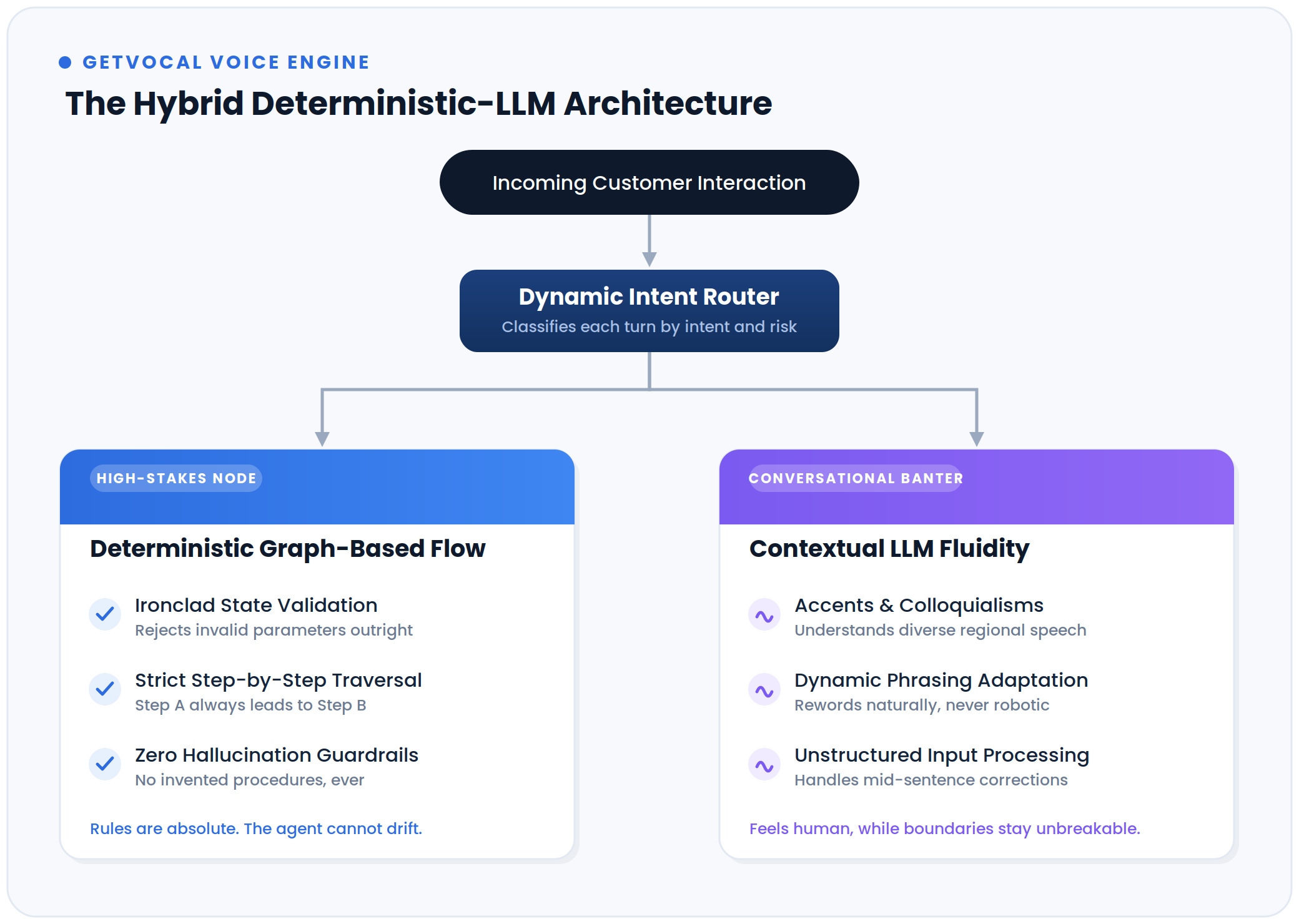
1. Hard Boundaries for High-Stakes Nodes
Critical workflows—like collecting employee IDs, validating alphanumeric usernames, or capturing sensitive dates—are mapped onto structured, graph-based state machines. Once a user enters this node, the rules are absolute. The agent cannot drift or accept invalid parameters. If a user tries to change the subject, the engine firmly but politely steers them back to complete the task, completely eliminating hallucinations.
2. Generative Connection for Casual Banter
Outside of those locked-down business nodes, the generative engine handles the connective tissue. It gracefully manages unstructured pleasantries, regional accents, colloquial phrasing, and sudden mid-sentence corrections (e.g., "Wait, my ID isn't 45, it's actually 47..."). The interaction feels natural and human, but the underlying operational boundaries remain unbreakable.
Overcoming the Noisy Environment Crisis
Global service desks often operate in high-density, acoustically challenging environments. When background noise collides with diverse regional accents, standard Speech-to-Text (STT) engines break down, resulting in frustrating loops of "I'm sorry, I didn't catch that."
An enterprise-grade platform solves this through a multi-layered validation framework:
RegEx & Structural Rules: Instantly matching transcribed tokens against explicit patterns (like a first.last username format) before advancing the call.
Omnichannel Fallback: If high background noise causes repeated voice validation failures, the agent automatically triggers an SMS authentication link or text data collection form. The user securely inputs their data on their phone, and the voice session resumes seamlessly without dropping the call.
Moving Beyond "Black Box" Analytics
For technically adept operations teams, generic metrics like "contained vs. abandoned" are hollow. They don't tell you why or where a call failed.
True operational transparency requires low-level execution visibility. Engineers need access to granular timestamps for every sub-component of a voice transaction—measuring STT latency, LLM inference time, and Text-to-Speech (TTS) synthesis down to the millisecond.
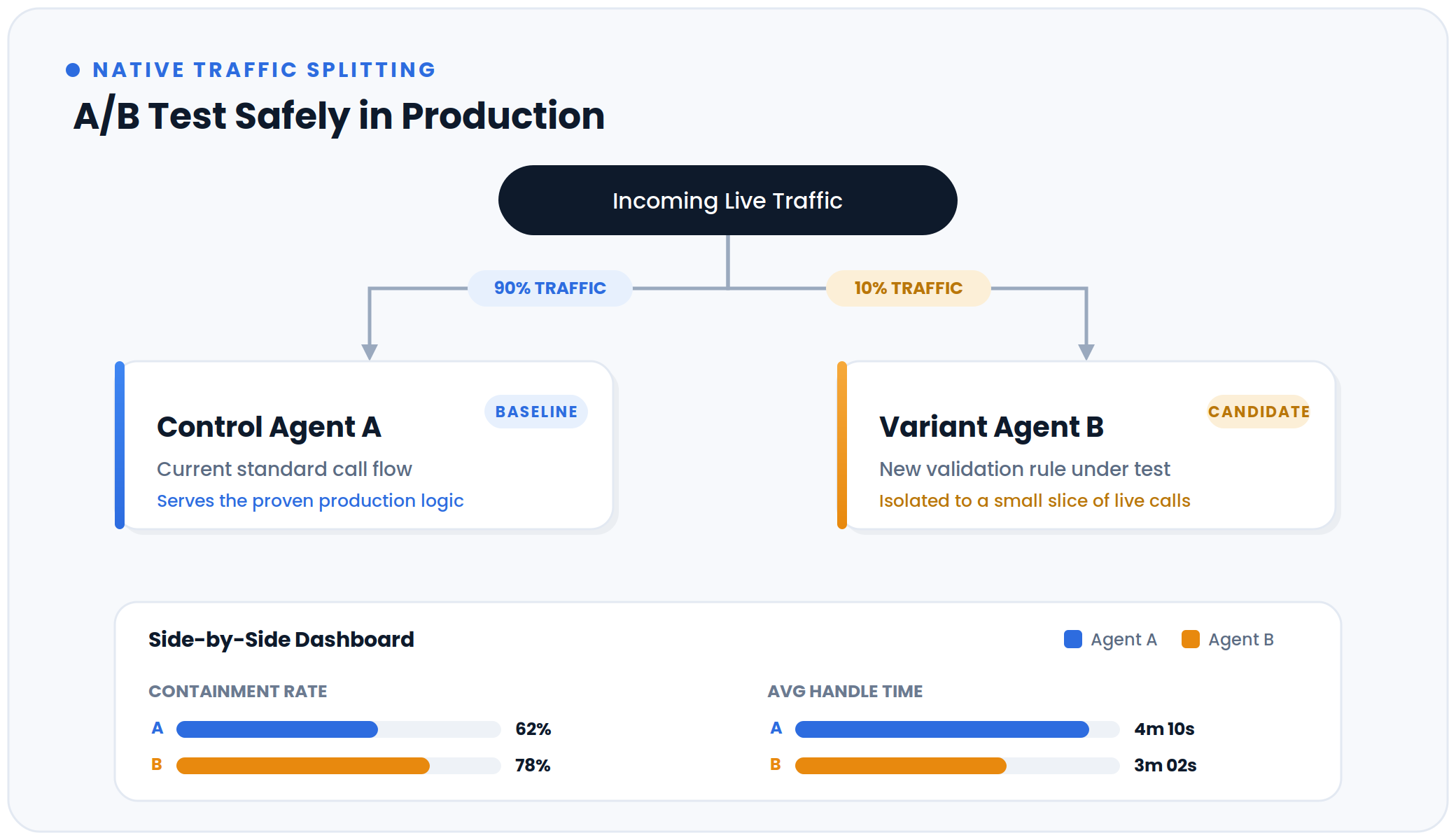
Furthermore, optimizing a voice asset shouldn't require risky live deployments. With native traffic splitting (A/B testing), teams can safely route a small fraction of live traffic to a variant agent with modified logic, directly comparing containment rates and handle times on a side-by-side dashboard before pushing updates to production.
Security Architecture is Non-Negotiable
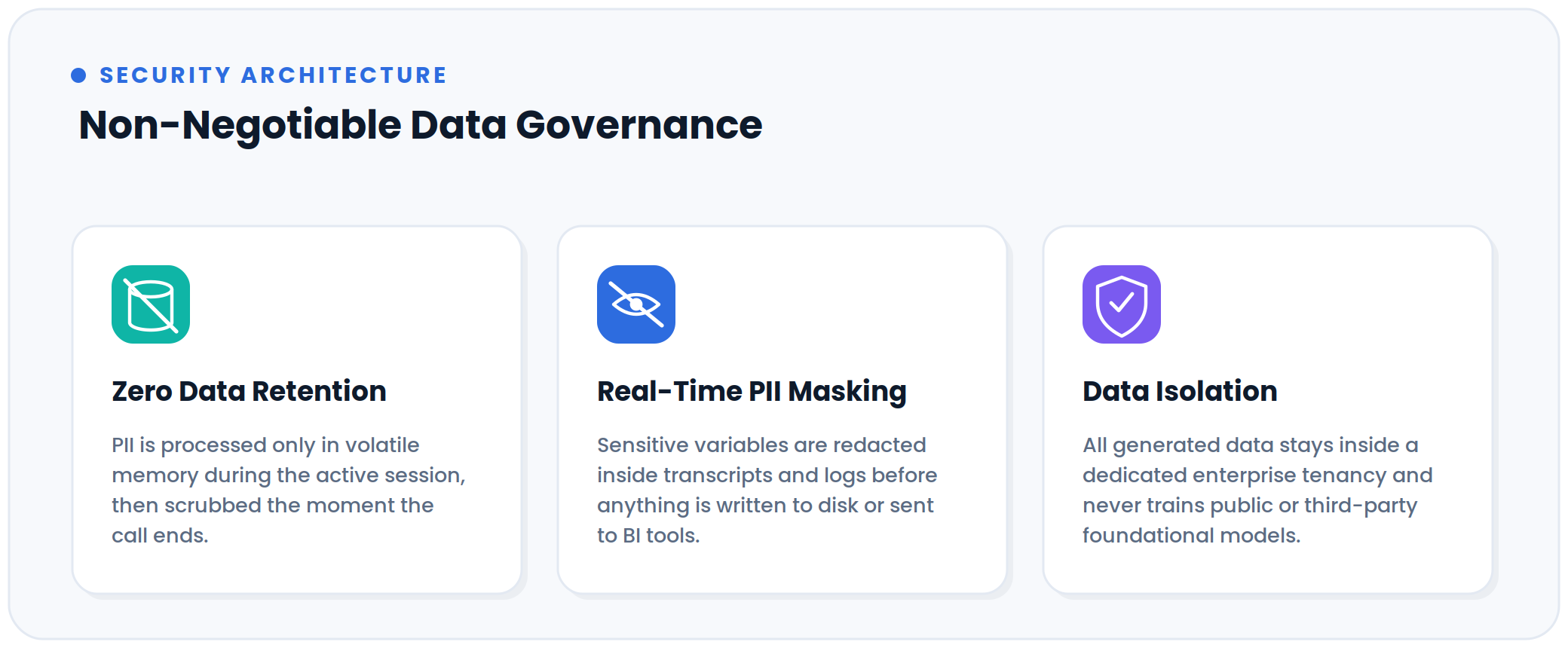
Deploying voice AI at scale requires ironclad data governance. Passing unencrypted employee or customer data through generic public APIs is a massive compliance vulnerability. Enterprise voice architectures must enforce:
Zero Data Retention (ZDR): Processing PII strictly in volatile memory during the active session transaction, scrubbing it completely the moment the call ends.
Real-Time PII Masking: Automatically redacting sensitive variables within call transcripts and logs before they are written to disk or exported to BI tools.
Data Isolation: Ensuring that all generated corporate data is completely isolated within a dedicated enterprise tenancy, guaranteeing it is never used to train public or third-party foundational models.
The Future of Voice Automation
The future of high-performance voice automation does not belong to unconstrained generative models that treat business rules as polite suggestions. It belongs to architectures that ground fluid generative capabilities within a predictable, deterministic state graph.
By taking control of the conversational flow, exposing deep technical metrics, and enforcing strict data security, enterprises can finally transform voice AI from an unpredictable experiment into a highly controllable driver of operational excellence.
Want to see how a hybrid deterministic-LLM engine can transform your specific service desk or contact center operations? Let's benchmark your current metrics. What is the average monthly call volume hitting your support desk today, and what is your target automation containment rate?
